


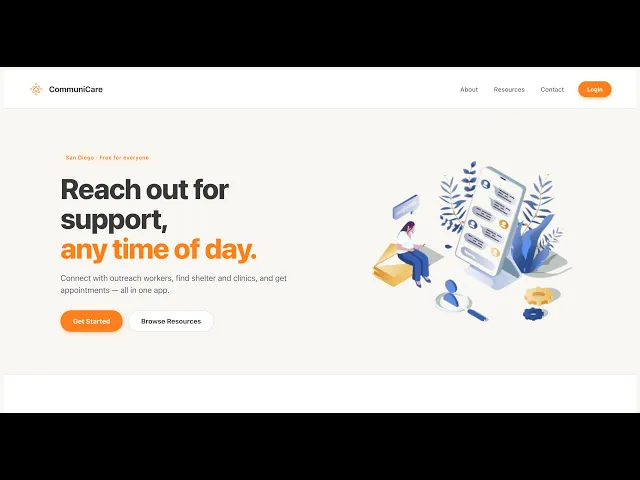
A communication platform to build trust and connection.

Overview
Keeping in contact
San Diego ranks among the highest in the US for populations of people experiencing homelessness.
For Father Joe's Villages, the largest homeless service provider in the city, dependable communication is key to building trust and delivering essential services.
Their outreach workers struggled with the challenge of maintaining consistent communication.
The Problem
Communication is critical
Instead of immediately designing, we went out into the community to listen. Through field research, site visits, 20+ user interviews, we gained critical information:
Findings: Unhoused Client Needs
A critical hurdle was that people held deep mistrust towards institutions including service providers, contributing to immense privacy concerns.
Despite this, the majority of our interviewees were deeply interested in strengthening their communication, particularly for resources, appointments, and emergency warnings.
Findings: Outreach Staff Needs
We needed to support outreach teams in building lasting connections and ensuring continued access to care. To do so, the design has to:
Be an easy-to-use digital plattorm optimized for low connectivity and basic devices.
Increase access to medical help, resources, direct service requests, & real-time staff communication.
Provide alerts and updates on weather, policies, and appointments.
Ensure accessibility with a simple interface and offline features on both client & staff interfaces.
Competitive Analysis

User Flows
Balancing trust, safety, & real-time alerts


Prototype
Designing for both sides
With new information in mind, we built a digital experience with Next.js/React frontend, styled with Tailwind CSS and custom CSS, deployed on Vercel:


Iterations
Design Refinement for Both Personas
In early May we began user testing our MVP with outreach staff, case workers, and the street health department. Some feedback we incorporated:
The map feature was incredibly critical for the Street Health team
Email notifications to outreach workers for new messages/locations
Being able to share 'pinned' locations

The Final Website
Introducing CommuniCare (View Site) ↗
We designed the website CommuniCare to provide a dependable, compassionate tool shaped around expressed needs that supports clients access essential resources in their move toward stability.
It includes:
Separate Client and Outreach Staff Interfaces
Direct, secure messaging with staff to address individual needs
A Live Map featuring event drops, FJV Street Health van tracking, & the ability to request medical assistance through location sharing
Comprehensive Resource Listings
Real-time alerts and updates
24/7 AI chatbot
Commitments to transparency and accessibility
Reflection
Learning Outcomes
Understood the communication barriers faced by people experiencing homelessness.
Applied user-centered design principles to create an accessible digital tool.
Developed practical solutions for improving service delivery through technology.
Collaborated effectively with community organizations and an interdisciplinary team to address real-world needs.
Evaluated the impact of digital tools on access to critical resources and support.
Future Improvements
If I were to revisit this work, I would:
Fix the map feature: it sadly appears to have been broken since we completed the MVP
Strengthen accessibility: A large percentage of individuals experiencing homelessness have disabilities and language preferences. We have basic translation features and our website passes contrast and font size checking, but accessibility can be even more reflected in our design.
Host the app on a server and connect it to a backend with a database so that chats can be saved across devices and browser sessions, instead of being lost when switching devices or clearing local storage.
Have an official domain